Petaddon
Guides and gear for exotic and small pets

Pet Relocation: How to Move Your Dog or Cat (and What It Costs)
Pet relocation means getting your dog or cat safely to a new home, across the country or abroad. You can fly your pet yourself in the cabin or hold, book it as airline cargo, drive it or hire a ground transporter, or hand the whole move to a pet relocation company that handles the flights, paperwork and door-to-door transport. Tell us about your move below and we’ll put you in touch with a pet transport specialist for a free quote.
More flying guides: flying with a pet · airline carrier and crate sizes · pet passports · French Bulldogs and snub-nosed breeds
Country and paperwork guides: pet move timeline (free tool) · Hawaii · Canada · Mexico · Puerto Rico · Europe · the UK · CDC dog import rules · rabies titer test · international relocation · ground transport
Your options for moving a pet
| Option | Best for | Typical cost |
|---|---|---|
| Fly with your pet in the cabin | Small dogs and cats that fit in an under-seat carrier | $100 to $150 each way in airline fees |
| Fly with your pet in the hold | Medium and large dogs on Alaska Airlines, the main US airline still offering it | $200 each way on Alaska |
| Airline cargo | Large dogs, or pets flying without their owner | Several hundred dollars to $1,000+ one way |
| Ground transport | Moves within the mainland US, nervous flyers, snub-nosed breeds | $200 to $1,200 cross-country |
| Pet relocation company | International moves, giant breeds, busy owners | From about $1,500 domestic; $4,000 to $6,000+ abroad |
For the full cost breakdown, see how much pet shipping costs or use our pet flight cost calculator. Not sure if your pet fits in the cabin? Try the cabin or cargo checker.

What a pet relocation company does
- Plans the route and books your pet’s flights or cargo space with airlines that accept pets.
- Supplies or sources an airline-compliant travel crate sized for your pet.
- Coordinates the vet visits, health certificate and USDA APHIS endorsement, plus any blood tests or treatments the destination requires.
- Handles customs clearance and import permits at the destination.
- Picks your pet up from home, boards it if needed, and delivers it to your new door.
For international moves, this paperwork is the hardest part to get right. One missed deadline can mean quarantine or a refused entry. Read our pet health certificate guide to see what is involved.
How to choose a pet transport company
- Check its USDA registration. Businesses that transport dogs for pay, including pet taxis and companies delivering pets to airlines, must register with USDA APHIS under the Animal Welfare Act. Look the company up on the USDA Animal Care public search tool.
- Look for IPATA membership. The International Pet and Animal Transportation Association is the trade body for pet shippers, with members in more than 80 countries. Find members in its pet shipper directory.
- Get an itemized written quote. It should show flights or transport, crate, vet and government fees, customs and delivery, so you can compare companies fairly.
- Ask who does what. Confirm who books the vet appointments, who submits the paperwork, and who meets your pet at each stop.
- Ask about heat and safety policies. A good company will route around hot hubs in summer, refuse unsafe conditions and explain how it handles snub-nosed breeds.
- Read recent reviews and ask for references from customers who made a similar move.

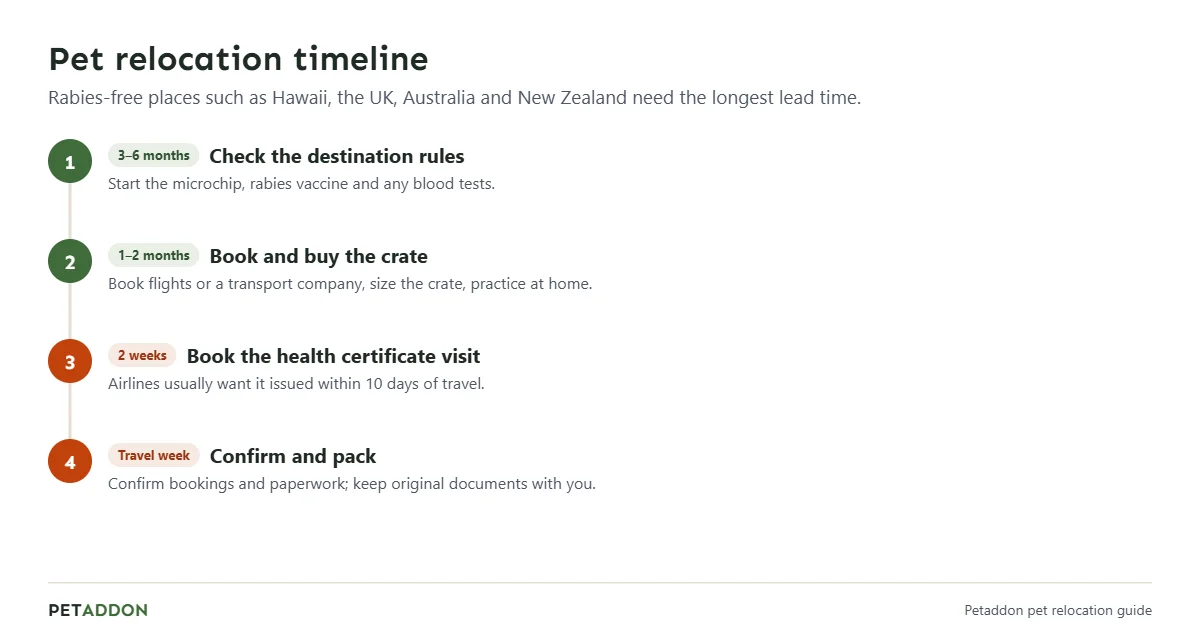
Pet relocation timeline
- 3 to 6 months before (international or Hawaii): check the destination rules, start the microchip, rabies vaccine and any blood tests. Rabies-free places such as Hawaii, the UK, Australia and New Zealand need the longest lead time.
- 1 to 2 months before: book flights or a pet transport company, buy and size the crate, and get your pet used to it at home.
- 2 weeks before: book the vet visit for the health certificate. Airlines usually want it issued within 10 days of travel, and many countries set their own window.
- Travel week: confirm bookings and paperwork, pack food and familiar bedding, and keep originals of every document with you.
Moving with a cat
Cats usually fly in the cabin, because they fit under-seat carriers on every major US airline. Get your cat used to the carrier weeks before the move, line it with something that smells of home, and keep the cat in one quiet room on moving day so it doesn’t slip out. At the new home, start with one room and expand from there.
Can you ship a dog with FedEx or UPS?
No. FedEx doesn’t ship dogs or cats for the public. To send a pet on its own, use airline cargo, such as Delta Cargo, American PetEmbark or Alaska Pet Connect, a ground transporter, or a pet relocation company.
Pet relocation FAQ
Can my pet travel without me?
Yes, as airline cargo, with a ground transporter or with a pet relocation company. Delta Cargo, American PetEmbark and Alaska Pet Connect all ship pets flying on their own.
How long does an international pet relocation take?
Weeks to many months, depending on the destination. Countries that require rabies blood tests can need 3 to 6 months of preparation before your pet can fly.
Is it safe to ship a pet?
Most pets travel safely, and the risk drops with good planning: a correctly sized, well-ventilated crate, direct routes, avoiding extreme heat, and extra caution for snub-nosed breeds. Talk to your vet before any move.
Do I need a pet relocation company?
Not for most domestic moves with a small pet that can fly in the cabin. A company is worth it for international moves, large or snub-nosed dogs, tight deadlines, or when you can’t travel on the same flight.
Related: pet-friendly airlines compared · pet health certificates · pet shipping cost · pet flight cost calculator
Sources: USDA APHIS: Activities with dogs requiring a USDA license or registration · IPATA · Starwood Pet Travel 2026 cost report · Starwood Pet Travel: pet transport costs · CitizenShipper: dog transportation cost · CitizenShipper: FedEx pet shipping. Last checked October 23, 2026.