Petaddon
Guides and gear for exotic and small pets


A hamster cage needs at least 100 x 50 cm of unbroken floor space: about 40 x 20 inches, or 775 square inches. That minimum comes from the German Veterinary Association for Animal Welfare (TVT), and the PDSA and Blue Cross use it for every hamster species. Syrian hamsters do better with 1,000 square inches or more. Most cages sold for hamsters fall short, including well-known brands.
Use the checker to test your own cage or a popular model. It also works out how much bedding to buy and the smallest safe wheel.
Contents
show
Hamster cage size calculator
Measure the inside of the base, wall to wall. Shelves, ramps and tubes do not count as floor space. Pick your hamster, then enter the length and width or choose a cage from the list.
Measure the inside of the base, wall to wall. Shelves, levels and tubes do not count as floor.
Enter the floor length and width, or pick a cage, to see how it compares.
Hamster cage size standards compared
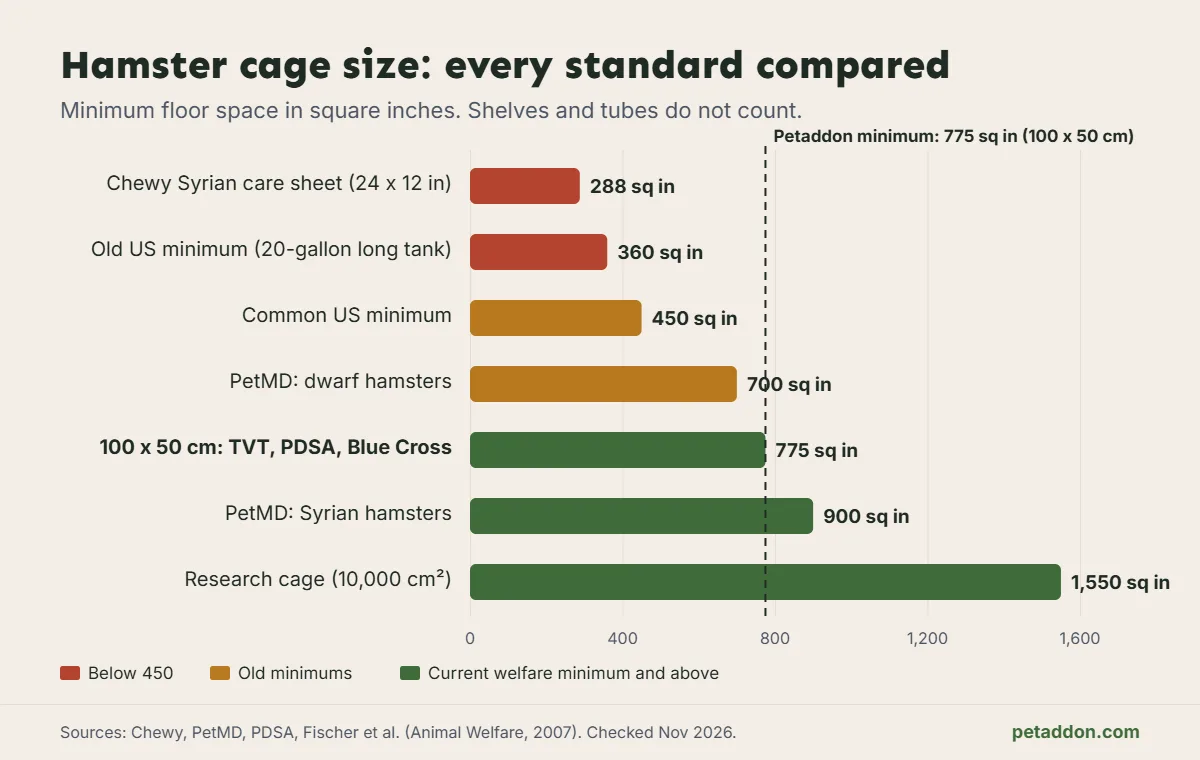
Ask five sources how big a hamster cage should be and you will get five answers. The table lists each standard, who sets it and what it rests on.
| Standard | Floor space | Who sets it | What it rests on |
|---|---|---|---|
| Chewy Syrian care sheet | 24 x 12 in (288 sq in) | Chewy, May 2026 | Lower than Chewy’s own cage guide |
| Old US minimum | 360 sq in | US hamster keepers | The floor of a 20-gallon long tank |
| Common US minimum | 450 sq in | Chewy cage guide, PetsRadar | A 2015 hamster forum decision, not research |
| PetMD, dwarf hamsters | 700 sq in (40 x 17.5 in) | PetMD | Vet-written guidance |
| 100 x 50 cm | 775 sq in | TVT (Germany), PDSA, Blue Cross | Welfare guidance for all species |
| PetMD, Syrian hamsters | 900 sq in (40 x 22.5 in) | PetMD | Vet-written guidance |
| RSPCA | No figure | RSPCA | “As large as possible”; dropped its figure for lack of evidence |
| Research cage | 10,000 cm² (1,550 sq in) | Fischer et al., 2007 | Behavior study of 60 Syrian hamsters |
The 450 figure is the one most US owners hear. According to The Ethical Hamster Care Guide, members of a hamster forum chose it in 2015 because it matched the largest IKEA bin they used, and the earlier 360 figure matched a 20-gallon long tank. Neither number came from a study.
Even one retailer disagrees with itself: Chewy’s cage guide asks for 450 square inches, and 900 for Syrians, while its May 2026 Syrian care sheet lists a 24 x 12 inch minimum. That is less than a third of the guide’s Syrian figure.
Our minimum: 100 x 50 cm (775 square inches) for every hamster, and 1,000 square inches or more for a Syrian. It is the standard UK charities and German vets use, it fits a proper wheel and a deep digging area, and it sits between the old forum numbers and the larger cages that helped hamsters in research.
What the research on hamster cages found
Two Swiss studies from the University of Bern tested cage size and bedding depth on Syrian (golden) hamsters.
- Cage size (Fischer, Gebhardt-Henrich and Steiger, 2007). The team filmed 60 female hamsters living alone in cages of 1,800, 2,500, 5,000 and 10,000 cm², each with a 30 cm wheel. Hamsters chewed the bars in every size, but those in small cages chewed longer and more often. The authors concluded that welfare seemed better in cages of at least 10,000 cm².
- Bedding depth (Hauzenberger, Gebhardt-Henrich and Steiger, 2006). Hamsters on 10 cm of bedding chewed the bars more and ran more on the wheel than hamsters on deeper bedding. Hamsters on 80 cm never chewed the bars, and every hamster on 40 or 80 cm dug a burrow and lived in it.
Bar chewing and nonstop wheel running are signs of a bored or stressed hamster. Both studies used Syrian females from a lab, so they do not prove an exact number for dwarf hamsters. They do show the direction: more floor and deeper bedding mean less stress behavior.
Syrian vs dwarf hamsters: what each one needs
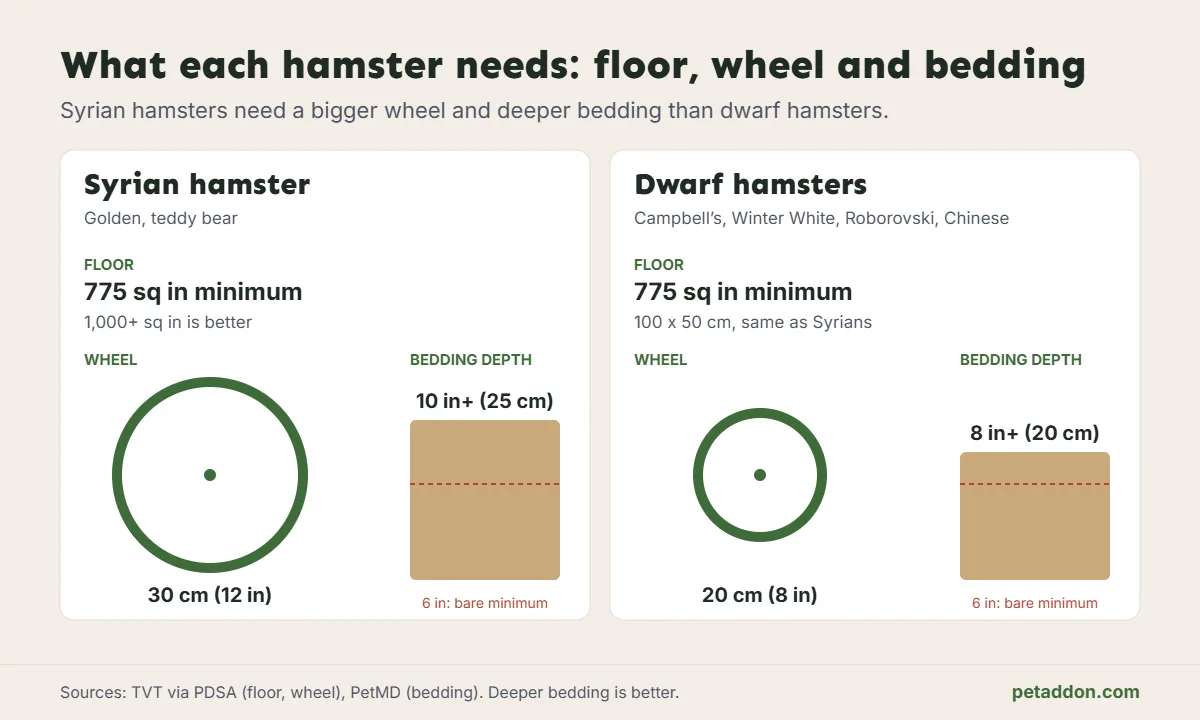
| Need | Syrian hamster | Dwarf hamsters (Campbell’s, Winter White, Roborovski, Chinese) |
|---|---|---|
| Floor space | 775 sq in minimum, 1,000+ better | 775 sq in minimum |
| Wheel | At least 30 cm (12 in) across | At least 20 cm (8 in) across |
| Bedding depth | 10 in (25 cm) or more | 6 to 8 in (15 to 20 cm) or more |
| Cage height | About 50 cm (20 in), enough for the bedding plus a lip | About 50 cm (20 in) for deep bedding |
| Company | Lives alone | One per cage is safest |
Dwarf hamsters are small, but they run and dig as much as Syrians, so the 100 x 50 cm minimum applies to them too. Syrian hamsters must live alone. Dwarf pairs can fight as they mature, so plan for a second cage if you keep two. Good housing is also one of the things that affects how long hamsters live.
Popular hamster cages measured
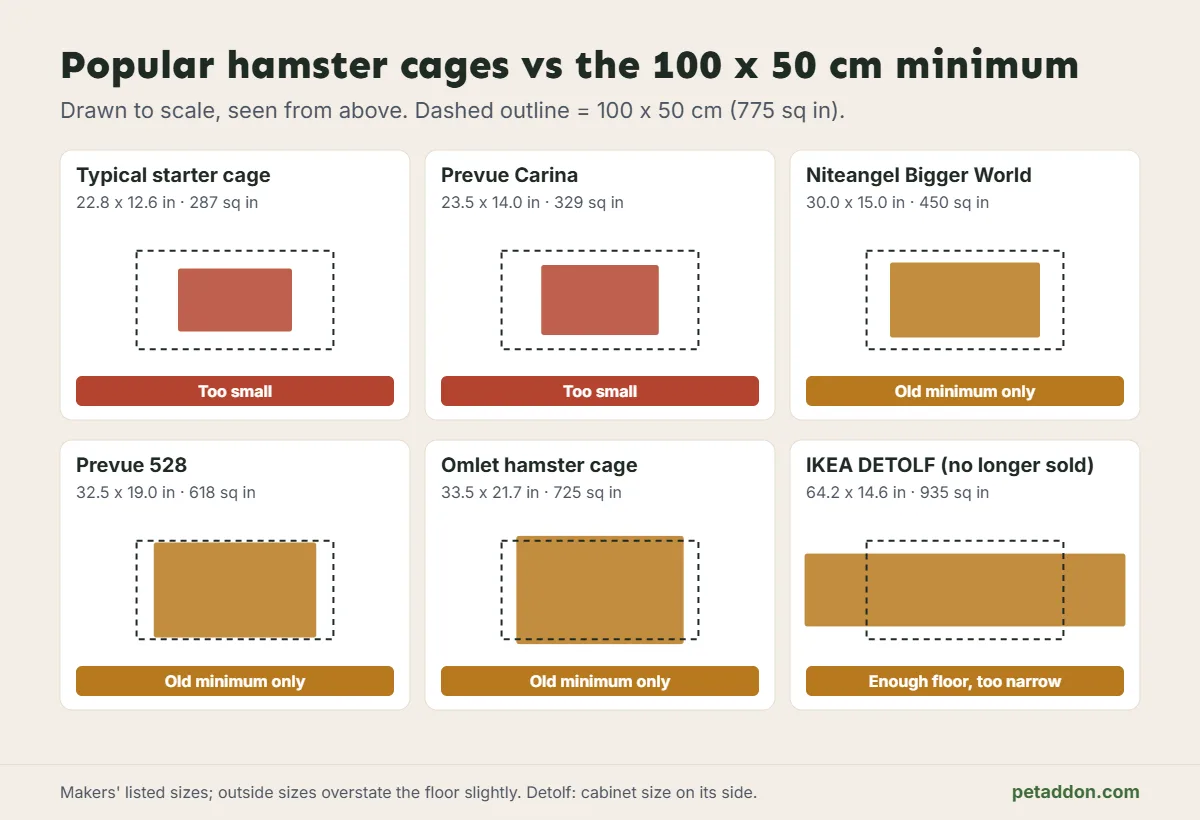
We ran six common cages through the checker using the makers’ published sizes. None of them reaches 100 x 50 cm.
| Cage | Listed size | Floor space | Result |
|---|---|---|---|
| Typical wire starter cage | 22.8 x 12.6 in | 287 sq in | Too small |
| Prevue Carina | 23.5 x 14 in | 329 sq in | Too small |
| Niteangel Bigger World | 30 x 15 in | 450 sq in | Old minimum only |
| Prevue 528 Universal Small Animal Home | 32.5 x 19 in | 618 sq in | Old minimum only |
| Omlet hamster cage | 85 x 55 cm inside | 725 sq in | Old minimum only |
| IKEA DETOLF on its side | 163 x 37 cm | 935 sq in | Enough floor, too narrow |
Outside sizes overstate the floor a little, so the real numbers for the Prevue and Niteangel cages are slightly lower. The Prevue 528 costs $124.99 at PetSmart yet still misses the minimum, so price tells you little about size. The IKEA DETOLF glass cabinet, a favorite of hamster keepers, has more than enough floor but is only 37 cm wide, and IKEA no longer sells it on its website.
Cages that reach 100 x 50 cm do exist, though most are sold in the UK and Europe, such as the Savic Plaza (100 x 50 cm) and the PawHut wooden cage (115 x 57 cm). In the US, the cheapest way to get there is often a large DIY enclosure or a converted piece of furniture. Measure it with the checker before you buy.
Why levels, tubes and add-on cages do not count
Every standard above measures one continuous floor. Chewy’s guide puts it plainly: measure length times width and leave out shelves, levels and tubes. A hamster needs one large area to run, dig and build separate spots for sleeping, food and a toilet. Two small cages joined by a tube give it two cramped rooms, not one big one.
How deep should hamster bedding be?
PetMD advises 6 to 8 inches of bedding for dwarf hamsters and room for at least 10 inches for a Syrian. UK vets at VetHelpDirect suggest 25 cm (10 inches) or more for all hamsters. The bedding study above found that hamsters on 40 cm (16 inches) or more all built burrows.
Deep bedding takes more than most people expect. A 100 x 50 cm cage filled 10 inches deep needs about 155 liters of paper bedding once it packs down, or two 85-liter bags. The checker does this sum for any cage. You do not need the same depth everywhere: a deep digging zone on one side and a shallower area around the wheel and food bowl works well.
Use paper or aspen bedding. Avoid scented bedding and cedar or pine shavings, which irritate a hamster’s airways.
What wheel size does a hamster need?
The TVT recommends a wheel at least 20 cm (8 inches) across for dwarf hamsters and 30 cm (12 inches) for Syrians, because smaller wheels bend the back and can cause lasting spine problems. Choose a solid running surface, not wire or rungs. If your hamster runs with its back arched, the wheel is too small. A 12-inch wheel stands about 13.5 to 14 inches tall, so check that it fits above the bedding.
What a hamster cage that passes costs
A cage that meets the minimum costs more than the hamster. Our hamster cost calculator puts the enclosure at $45 for a large bin cage, $125 for a mid-range cage and about $250 for a large habitat. With a 12-inch wheel, deep bedding, hides and a water bottle, a typical setup comes to about $260, then about $355 a year for food, bedding and a checkup.
Hamster cage size FAQs
Is a 450 square inch cage big enough for a hamster?
It meets the old US minimum, but not the current welfare minimum of 100 x 50 cm (775 square inches). For a Syrian hamster, 450 square inches is about half of what PetMD recommends.
How big should a Syrian hamster cage be?
At least 100 x 50 cm (40 x 20 inches, 775 square inches), and ideally 1,000 square inches or more, with room for 10 inches of bedding and a 12-inch wheel. PetMD recommends 900 square inches for one Syrian.
How big should a dwarf hamster cage be?
The same: at least 100 x 50 cm. Dwarf hamsters are small but very active, and the TVT, PDSA and Blue Cross apply one minimum to every species.
Can a hamster cage be too big?
No. A big cage only feels too open if it is bare. Fill it with deep bedding, several hides, tunnels and cover so your hamster always has a place to duck into.
How do I measure a hamster cage?
Measure the inside of the base from wall to wall, length and width, in inches. Multiply them for the floor space in square inches. Ignore shelves, levels and tubes. For a tank or bin with sloped sides, measure at the bottom.
Does the RSPCA have a minimum hamster cage size?
Not anymore. The RSPCA says a cage should be as large as possible and no longer gives a figure, citing a lack of evidence. The PDSA and Blue Cross use 100 x 50 cm.
Sizes and prices checked 24 November 2026. Cage sizes are makers’ published figures, not our own measurements. Sources: PDSA: the ideal home for your hamster; VetHelpDirect: hamster cage size; PetMD: hamster cages; Chewy: best hamster cages; Fischer et al. (2007), Animal Welfare 16(1); Hauzenberger et al. (2006), Applied Animal Behaviour Science 100: 280; TVT wheel guidance (via Wikipedia); PetSmart: Prevue 528; House Digest: IKEA DETOLF. Not veterinary advice. Featured photo: Sunira Moses / Unsplash.